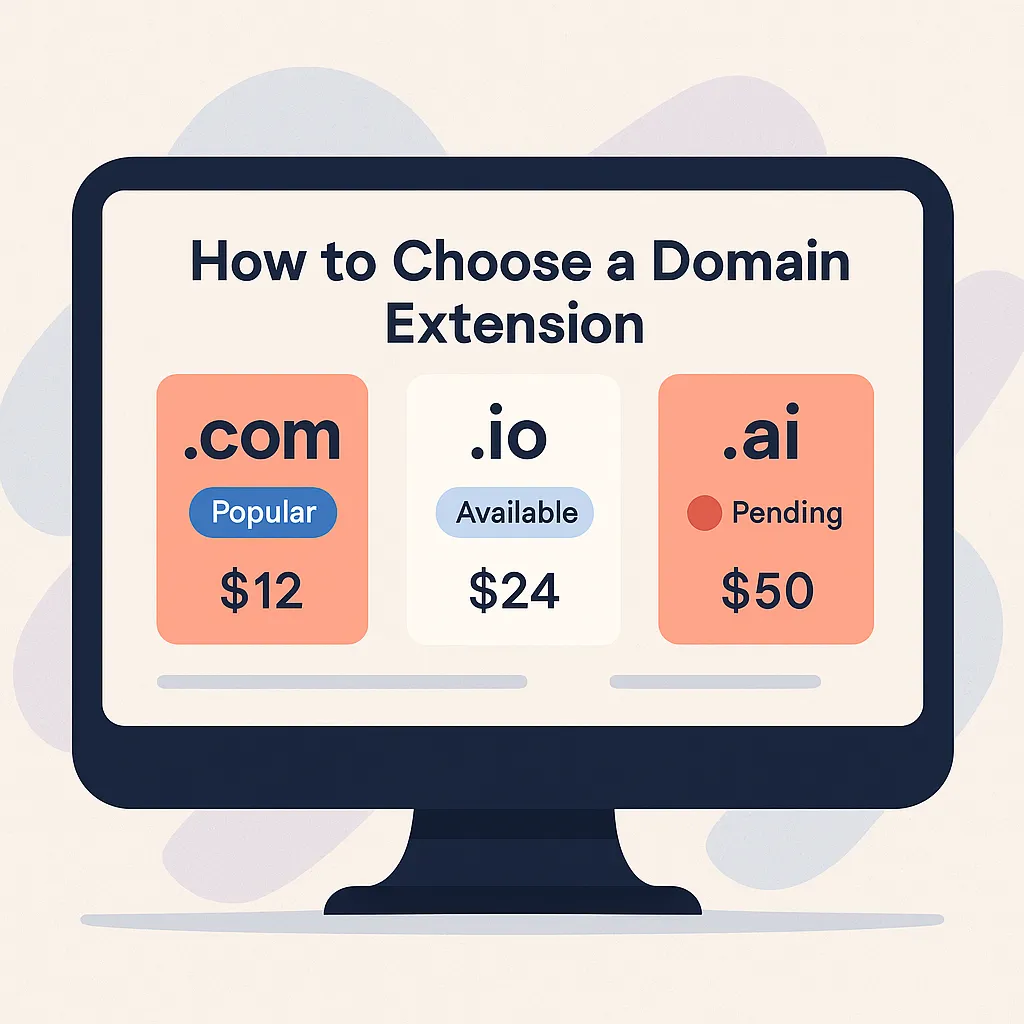
How to Choose a Domain Extension: .com vs .io vs .ai (Founder’s Guide)
Default to .com — it has the highest consumer trust and is what people type by habit. If .com is taken, match your industry: .ai for AI products, .io for tech/SaaS, .co as a general alternative, or .app for developer tools. Verify your choice across matching social handles before committing.
Describe it. Ship it today.
Lovable turns your description into a working, deployed app — not a mockup. Free plan gives you 30 credits a month; Pro starts at $25.
The .com is taken. Or worse — the owner wants $25,000.
Welcome to the most annoying part of starting a business.
Suddenly you're staring at a wall of alternatives: .io, .ai, .co, .app, .xyz.
Are they legit? Will customers trust them? Will Google punish you for not using a .com?
Here’s the short version: your Top-Level Domain (TLD) is part of your brand identity.
It affects trust, click-through rates, and first impressions. But you don't need to mortgage your runway to win. Smart founders pick the extension that fits their audience, industry, and stage.
The 60-second decision framework:
- Default to
.com— highest trust, what people type by habit. Register it if it's free. - If
.comis taken, match your industry —.aifor AI,.iofor tech/SaaS,.coas a general alternative,.app/.devfor developer tools. - Avoid low-trust TLDs for consumer brands —
.xyzand obscure extensions can look spammy and cost you clicks. - Check the domain and matching social handles before committing, so your brand is consistent everywhere.
What a Domain Extension (TLD) Actually Is
A Top-Level Domain (TLD) is everything after the dot in a URL. They usually fall into three buckets:
- gTLDs (Generic TLDs):
.com,.net,.org - ccTLDs (Country Code TLDs):
.uk,.ca,.io,.ai— some (like.ioand.ai) behave as generic because of wide usage - New gTLDs:
.app,.shop,.tech,.online— industry-specific and descriptive
Your TLD is a signal. .shop hints e-commerce. .edu screams education. Choose intentionally.
Why .com Is Still the Gold Standard
The human brain defaults to .com. Say your startup is “Spark” — most people will instinctively try spark.com.
Why .com still wins
- Highest consumer trust
- Best for offline marketing (radio, billboards, packaging)
- Familiar to all audiences, especially non-technical users
When you should prioritize .com
- You’re a consumer-facing brand (B2C)
- You sell physical products or services to non-tech users
- You rely on offline channels where people manually type URLs
When not to obsess
- The
.comcosts more than your runway - Only awkward variations are available (e.g.,
spark-company-official.com) - You’re a tech-first product with a developer audience
If the .com is priced reasonably, buy it. If not, there are smart alternatives and workarounds (see: What To Do If Your Business Name Is Taken).
Why Tech Startups Love .io
.io started as a country code but became the unofficial TLD for startups.
Why it works
- Signals tech / developer culture
- Clean, short, and modern aesthetic
- Better availability than
.com - Treated by Google as generic (no SEO penalty)
Price range
- Typically around $30–$50/year — more than
.comretail pricing, but far cheaper than a $25k aftermarket.com.
When to pick .io
- Building SaaS, developer tools, or B2B software
- Your audience is technical
- You want a short, brandable name and
.comis impossible
Examples: sentry.io, expo.io, raycast.io
The .ai Explosion — Great for AI-First Companies
.ai has become the go-to for AI startups. It signals “we do AI” instantly.
Why it works
- Strong instant signal to investors and users
- Perceived as premium and innovative
Caveats
- More expensive (
$60–$100+/yearfor many registrars) - Can box you in if AI is not core long-term
- Attracts speculators and quick resellers
When .ai is worth it
- AI/ML is your core technology
- You’re targeting AI-savvy users and investors
Examples: perplexity.ai, runway.ai, character.ai
Other Extensions: .co, .app, .dev, .xyz, etc.
Quick breakdown:
.co— short and startup-friendly. Watch out for typos to.com..app— owned by Google, requires HTTPS, great for mobile/web apps..dev— perfect for developer tools and SDKs; niche but credible..xyz— cheap, flexible, popular in Web3; can feel spammy to older users.- Industry gTLDs (
.shop,.studio,.tech) — useful when highly relevant and descriptive.
SEO Myths — What’s Actually True
Myth: “Google ranks
.comhigher.”
Truth: Google treats major TLDs (.com, .io, .ai, etc.) the same. Rankings depend on content, backlinks, and UX.Myth: “.io/.ai get penalized.”
Truth: False. They’re treated as generic in most use cases.Myth: “New TLDs can’t rank.”
Truth: They can. However, user trust and click behavior can indirectly affect SEO.
How to Choose a Domain Extension — A 5-Step Founder Framework
Use this to decide in 60 seconds:
Who’s your audience?
- Non-tech consumers →
.com - Developers / B2B →
.ioor.dev - AI-first product →
.ai - Mobile app →
.app
- Non-tech consumers →
Can you afford the
.com?- If it’s a standard price (e.g., <$20/yr), buy it.
- If it’s thousands, prioritize runway.
Does the extension scale?
- Would
bakery.ailook weird if you expand?
- Would
Check cross-platform availability
- Domain + social handles = brand consistency.
- Use our name checker to validate everything (domains + socials) in one go. See also: How to Check Domain Name Availability and How to Check Social Media Handle Availability.
Avoid the competitor trap
- If a competitor owns the
.com, don’t launch on.iowith the same name — you’ll lose traffic.
- If a competitor owns the
Fast Practical Tips & Workarounds
- Modifier trick:
getbrand.com,trybrand.com,brandapp.com— clean and usable. See: What To Do If Your Business Name Is Taken. - Buy variations: Grab common misspellings and redirect them to your site.
- Consider timeline: Launch with
.ioor.appand upgrade to.comlater if affordable. - Check domain history: Use Wayback Machine / Ahrefs to avoid toxic history.
Examples — Big Brands That Didn’t Start on .com
- Notion → started on
notion.so(later acquired.com) - Figma → initially used
figma.io - Twitch →
twitch.tvwas perfect for streaming - Linear →
linear.app - Loom → launched with alternative TLDs then upgraded
Lesson: product > extension. Great products make domains memorable.
Final Takeaway
Don’t let the perfect domain delay building the perfect product.
- Prioritize
.comfor broad consumer trust. - Use
.iofor developer/SaaS audiences. - Reserve
.aifor authentic AI-first products. - Always verify domain + social availability before you get attached.
Want to validate dozens of TLDs and social handles in one search? Try a tool that checks all of them in one go — it saves time and naming heartbreak. See: Business Name Generator With Availability Check
Pro Tip: Secure your brand handles early. Even if you aren't ready to build your website or post content yet, registering your brand name across key platforms prevents squatters from hijacking your identity later.